
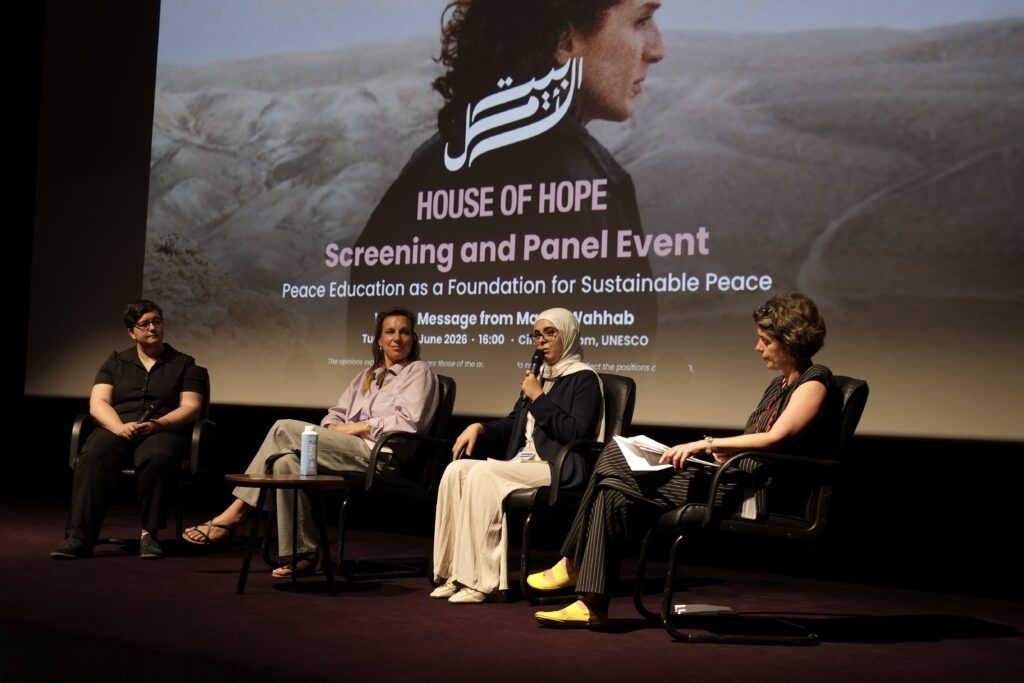
At UNESCO Headquarters in Paris this week, a screening of the award-winning documentary House of Hope brought the story of a Palestinian West Bank school to policymakers, UN agencies, educators and civil society organisations. This blog post is a write-up of the event, which centred on the urgent need for trauma-informed education in crisis situations, and urged decision-makers to advance education for peace as a strategic priority.
Co-hosted by the the Permanent Delegations of Spain, the Kingdom of the Netherlands, and the State of Palestine to UNESCO, and supported by Think-Film Impact Production, the special screening event gathered global diplomats, policymakers, and peacebuilding experts around a singular call: prioritise education as a non-negotiable pillar of sustainable peace and reconstruction in the Middle East region.
House of Hope follows a Palestinian teacher, Manar Wahhab, for three years as she teaches primary school pupils at a Waldorf-inspired school in al-Eizariya, West Bank. Together with her husband, Milad, Wahab’s trauma-informed, holistic peace education methods – rooted in the legacy of Rev. Dr. Martin Luther King Jr. – offer hope and a future to children living under occupation in some of the most difficult conditions imaginable.
Marjolein Busstra, the film’s director, shared how personal this story is to her, saying: “House of Hope is a film born from a relationship with Manar, a Palestinian woman I first met eighteen years ago and who has become a close friend in recent years. She believed so deeply in Waldorf education that she built the first school of its kind in the West Bank. As a mother whose own child attends a Waldorf school, I know what it means to want your child to grow up with space for feeling, for creativity, for the full unfolding of who they are. That is what Manar and Milad are fighting for. And yet I am acutely aware of the painful contradiction in speaking about education while a genocide is taking place where tens of thousands of children have been killed since 7 October 2023, under Israeli military occupation.”
Wahab, co-founder of the school, added her comment to the event via a special video message, saying: “At House of Hope, we don’t just seek academic achievement, we seek a holistic kind of education that heals and supports children’s head, heart and will. Peace is not just a word for us, it’s a daily action. I encourage everyone – peacebuilders, teachers, mothers and families – to seek peace in education for the children and community.”
Commending the film, His Excellency Miquel Iceta, Ambassador of Spain to UNESCO, and Her Excellency Monique van Daalen, Ambassador of the Kingdom of the Netherlands to UNESCO, noted that House of Hope demonstrates how peace education can be practiced under some of the most difficult conditions imaginable, and shows governments the importance of investing in trauma-informed, locally led educational approaches that promote healing, civic participation and social cohesion.
UNESCO’s Recommendation on Education for Peace, Human Rights and Sustainable Development, whose core message is that learning plays a transformative role in shaping a peaceful future for all, was highlighted during the event. House of Hope offers a case study of a living school that embodies many of the principles enshrined in the Recommendation, and shows why a human-centred, dignity-based approach to teaching is so critical – to transmit values, attitudes, critical thinking, agency, and cultures of collaboration. To implement the Recommendation fully, governments need to do more to recognise the critical role teachers play in society – including by supporting their well-being, physical and psychological, and providing fair remuneration, training, digital tools, opportunities to make learning context-specific, and enabling international collaboration opportunities.
While the film shows children learning and growing in an environment of warmth and healing, their experience at House of Hope school cannot be separated from the intensifying violence outside the school gates. In Gaza, Israel has killed over 20,000 children and injured 44,000 more since 7 October 2023, an estimated 700,000 Palestinian children have gone without in-person formal education for nearly three consecutive academic years, and almost 98% of educational facilities are now damaged or destroyed.
Batool Abu Akleen, a Palestinian poet and university student, shared her own experiences of education under fire in Gaza – both studying and through volunteering as a teacher, saying: “In 2008, a building next to my kindergarten was bombed by the Israeli forces, and my parents thought that I died. This is not what normal life should be. Children just want to be children. How will these children at the House of Hope school be able to change the future if they are not even allowed to exist in the future? I believe that change should start from the educational system outside Gaza and Palestine – we need to teach all young generations to stand against oppression, and to question things rather than just taking them as matters of fact.”
Closing the event, His Excellency Mr. Atieh, Ambassador for Palestine to UNESCO gave all in attendance a reminder that the work of peace is only just beginning. He said: “House of Hope is a portrait of Palestinian children and teachers struggling to preserve their humanity in circumstances that challenge them on a daily basis. I admire those children and pay tribute to their teachers. I really admire Manar Wahhab for her dedication to this program. Peace education remains one of the pillars of UNESCO and one of the pillars and the commitment of the Palestinian Authority. But let me be clear: peace education itself is not enough. We have political responsibilities to guarantee conditions conducive for peace education. The problem is not the dedication of the Palestinian government, the people, or the students. The most challenging thing for peace education in Palestine is the reality on the ground. How can we convince our children to see the other as a partner when the reality surrounding us is violence, occupation, apartheid, and discrimination?”
Abu Akleen’s presence at the event implicitly underscored that education will determine the future of her generation. While UNESCO, private actors, and NGOs actively drive localised education initiatives, much more needs to be done to ensure that broader humanitarian systems and frameworks centre education, and that peace negotiations actively consult and include local educators, students, and children’s advocacy organisations. Education for every child and young person that instills values of coexistence and respect should not come as an afterthought to reconstruction, but as its foundation.
This timely event comes shortly ahead of UNESCO’s Transforming Education Summit +4, taking place on 10th July. This event will set the global education agenda beyond 2030, and specifically discuss education in crisis situations. House of Hope offers something rare ahead of that moment: living proof that peace education is not a theory, but a practice already underway and working.
House of Hope is produced by 100% Film and Philistine Films. It premiered at International Documentary Festival Amsterdam (IDFA) in November 2025 and won Best International Feature Documentary at HotDocs Film Festival 2026. It screens next at the Jerusalem Arab Film Festival.